

HB 501 Proposes to Tax All Utahns’ Water Bills for Water Projects that Damage the GSL
A new bill at the Utah Legislature proposes a new tax on all water bills to fund the expansion of Utah government and pay for gigantic water projects that could harm the Great Salt Lake and divert water out of the Colorado River. HB 501 would set a tax on municipal water rates and sewer bills to fund water development projects inside Utah state government. Utahns currently pay property taxes on their cars, housing, and businesses for water, they pay two different sales taxes for water, and now they would pay a new tax on all their water bills.
The bill does not specify which water projects would receive these funds, but big water projects that are currently authorized and collecting sales tax funds include both the $3–4 billion proposed Bear River Development and $3–4 billion Lake Powell Pipeline. Smaller water projects could also be funded by these taxes.
The tax would be determined in part by a collection percentage based on the median income in a given water supplier’s service area. This means that in communities like Salt Lake City, where the median income is significantly higher than the household income in poorer communities, the working poor will pay a disproportionately large amount compared to wealthy households on the east bench and upper avenues.
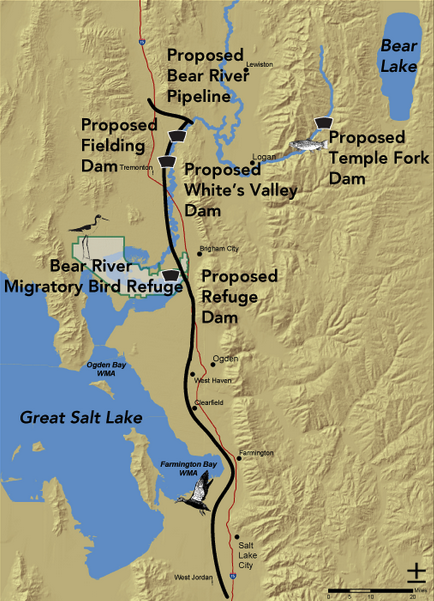
Bear River Development is a controversial water project that would be the death knell for the Great Salt Lake. Proposed Bear River Development would divert the Bear River to the lawns of the Wasatch Front upstream of the Great Salt Lake. Because the Bear River is the single largest source of water to the Great Salt Lake, proposed Bear River Development would lower lake levels dramatically, impacting air quality and wetland bird populations. 20–30% of the river’s flow would be diverted upstream of the lake, totaling as much water as a city of 1.5 million people use in a year.
All Utah residents will eventually pay this tax, but that doesn’t mean they’ll receive any water from the projects they will be taxed to fund. Worse yet, the biggest water wasters along the Wasatch Front — secondary water users — will not have to pay this tax. Utah’s farmers — the state’s biggest water users — won’t pay this tax either, except in their household water bills. Agriculture uses 80–85% of all the water used in Utah.