Downwind: A Coalition Report on Utah's Great Salt Lake Dust Crisis
For over a year, the Great Salt Lake Waterkeeper has partnered with Utah Physicians for a Healthy Environment to research and summarize the public health impacts and mitigation costs of the toxic dust crisis brewing at the Great Salt Lake caused by Utah’s failed water policies. The result of this collaboration is an expansive new report called Downwind which examines this crisis in extensive detail with over 500 references and 120 pages of material.
Why is the Great Salt Lake's dust so toxic?
The Great Salt Lake is a terminal lake, meaning it has no outlet, so compounds from industry, agriculture, and cities have accumulated in the lakebed for nearly two centuries.
The Great Salt Lakebed contains fine grains of dust and deposited toxins, including PFAS, arsenic, mercury, radionuclides, microplastics, neurotoxins, pathogens, harmful organic compounds, and other pollutants.
When wind blows across the exposed lakebed, it picks up these dust particles and intermeshed toxins and transports them toward Utah’s population centers along the Wasatch Front, exposing the population to toxic dust. It isn’t just storms that can carry these toxins into our airshed. Winds as slow as 10 miles per hour can carry this dust into the air column where it can remain for as long as a week, impacting public health long after the wind dies down.
The dust from the desiccated Great Salt Lake lakebed has generational health implications, threatens the state economy, and destabilizes our communities as residents leave the region due to air pollution concerns. Those who remain will be left with substantial mitigation and healthcare costs.
What is Utah doing about this crisis?
Unfortunately, Utah state government has given up on solving this problem by restoring the Great Salt Lake. The surface area the lake must cover to prevent toxic dust emissions and protect public health is roughly 1,700 square miles. In the Fall of 2025, the Great Salt Lake’s surface area spans only 950 square miles and its water level is 4,191 feet above sea level, dangerously close to its 2022 record low of 4,189 feet. The least expensive way to preserve the lake and a healthy future for the millions of people living downwind is to reduce upstream diversions to the lake’s rivers. But so far, they are shirking their obligation to do so.
This will lock the state into costly mitigation programs, necessitating billions upon billions of taxpayer and spending that could easily be avoided. Many of the actions taken at the Utah statehouse over the last several years – which have been promoted as advancements – are actually further drying up the Great Salt Lake.
Utah has historically failed to even invest in the air monitoring systems we need to understand the scope of the dust pollution problem so that less information is available to the public about toxic dust exposure.
How much will dust mitigation cost?
Utah clearly intends to shrink the Great Salt Lake down to a smaller footprint and implement a future of endless public spending on a range of exorbitant technologies like those used at Owen’s Lake in California. These technologies include mitigation methods like sprinkling the dry lakebed’s most emissive sections (dust hotspots) with water. Over the last two decades, mitigation at Owens Valley has cost over $2 billion, but the Great Salt Lake is roughly sixteen times the size of Owens Lake.
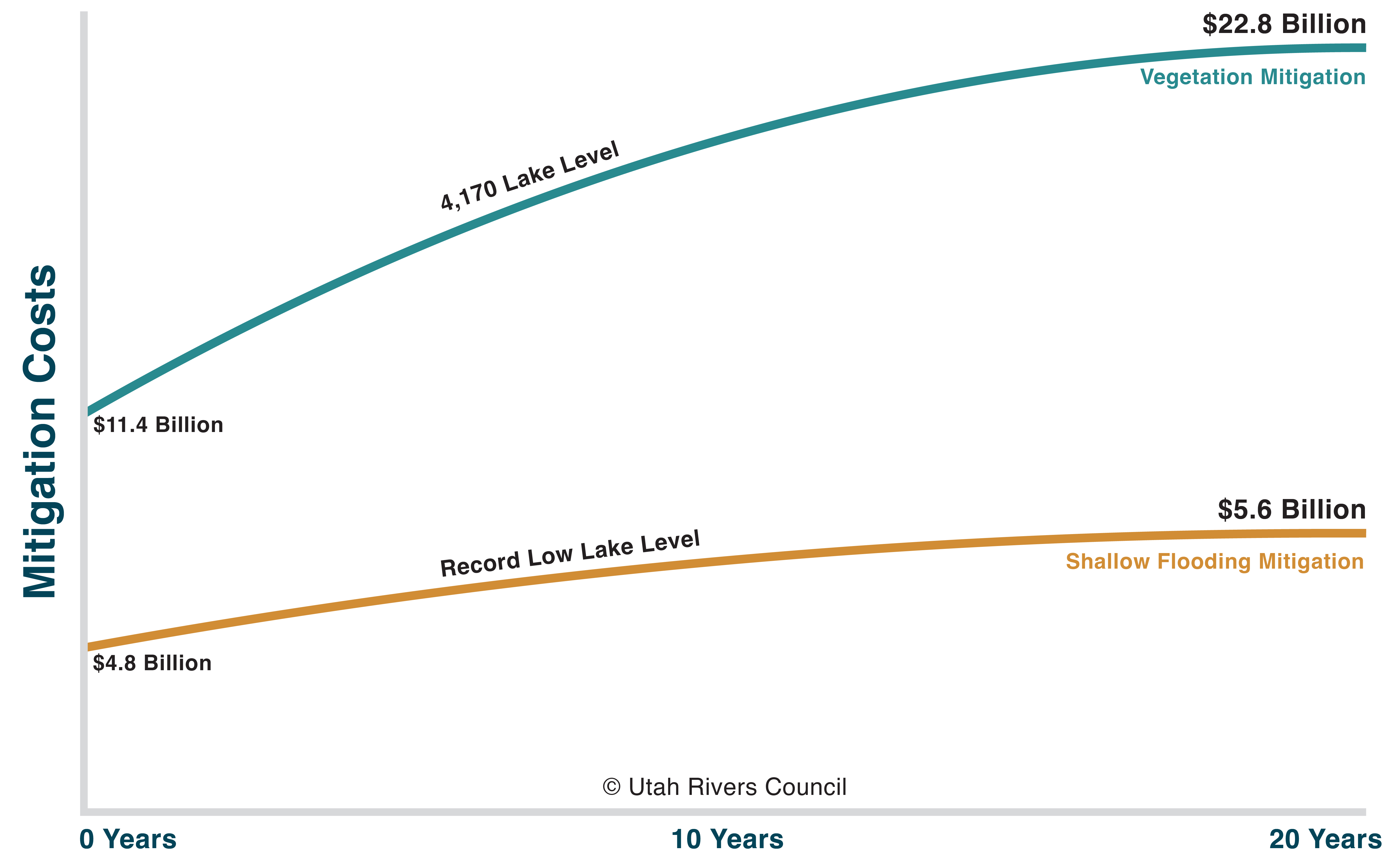
Mitigation of Great Salt Lake dust could cost up to $22 billion over 20 years, many billions of dollars more than regulating upstream water diversions properly.
Great Salt Lake Dust Mitigation Cost Estimates